Technique and its application

‘Correspondence with the object’ in painting, was not
interpreted by the painters as a call for absolute realism, that is, for
landscapes to be reproduced in rigid exactitude. Rather as the painting
tradition developed in China the tendency was to move toward placing spiritual
values above realistic expression. The way of recreating landscape in a
painting was to find a way of allowing the landscape to unfold itself in a
manner that to allowed the viewer to participate in the process. In a single
picture we can be presented with a multiple of viewpoints as there is no
adherence to a rigid system of a singular point of view with a corresponding
vanishing point as one would find in Western perspective. The painting unfolds
before us because we are moving about within that landscape seeing it first
from one position and then from another. This movement, the shifting of
perspective, is what allows us to participate in a journey amidst the landscape
being presented. The landscape we experience is created layer upon layer, each
layer superimposing experience over experience, until we are saturated in the
landscape. At that point we then belong to the landscape and the landscape
belongs to us
 |
| Joei-ji, designed by Sesshu. |
Both painters and garden creators are concerned with the
representation of depth in a composition.
Garden creators have an advantage in that they are working in three
dimensions, whereas painters have a flat, two dimensional, space to work in.
Depth is the key to allow the eye and mind of the viewer to roam, to move about
in a composition. For the garden creator this may be physical as well as purely
visually.
 |
| Guo Xi - Level Distance |
With the garden our experience is nuanced and layered, and
because the garden is a three-dimensional creation its relationship to the
viewer becomes spatially more complex. If in a painting the ability of the
viewer to ‘move’ through the landscape is an interiorized capacity, in the
garden it becomes exteriorized and
interiorized by body and mind as
a whole. Even with those gardens that are viewed from a building the viewer is
able to register depth in a garden composition in a more visceral manner.
 |
| Guo Xi - 'observing from above' |
When we look at the paintings it is clear that there is a
strong underlying organisation of the constituent parts of a composition. The
most obvious manner in which this is done is by the use of triadic,
asymmetrical, composition. That is, through the organisation of the principal
elements according to triangular relationships between them. Very often in a
painting the particular components elements of the painting are broken down into
groups of three. Within the group of three, one element stands out as being the
primary and the other two parts play a supportive role. This relationship is
often expressed as ‘Host and Guest”. Li Cheng 李成 (919–967) a Sung dynasty painter puts it
this way: “In painting landscapes, one should decide first upon the positions
of the host and guest mountains and then on the relative distance of objects.
After that he (the painter) can mark out the scenery and the objects, and
arrange the high and low.”
In East Asian art perspective is not expressed in the linear
(straight line) manner in which it is normally expressed in Western art., where
perspective lines extend towards a notional horizon where they are swallowed by
a vanishing point. In nature, in wildness, there are no straight lines. Rivers
meander and forests are not composed of trees growing in regimented order
equidistant from one another. There is a more subtle, flexible organisation,
which speaks a language of interrelation and interaction between elements. It
is an organisation that is organic, dynamic, ever shifting and developing
according to constantly varying environmental conditions; the path of the sun,
the shape of the landscape itself. Chinese painting reflects this quality very
well.
 |
| Looking Up From Below. |
 |
| Observing Landscape From Above. |
Painters used what has been called the ‘three perspectives’.
This was first formulated by the painter Guo Xi 郭熙 (1020-1090), and he referred to it as
‘floating perspective’. In his method the viewer is looking at the landscape
from three different places: in the first he/she is looking up into the
landscape from below. In the second the viewer observes the landscape as if
floating some way above it all. In the third view (‘level distance’) the viewer
regards the landscape from a high vantage point with the landscape stretching
away into the far distance. These perspective effects can be found in the rock
composition of the Daisen-in garden. In most cases the painters would evoke one
or two of these forms of perspective, though in some cases all three were used in
the same painting. In the paintings and gardens vertical lines suggest the
relative position of forms and imply a sense of depth. Horizontal lines establish stability
and give balance to the composition, while transitions and connections in the
various elements of the composition are indicated by diagonal movement.
Outlines soften with increasing distance from the source, detail is lost, and
shape begins to dissolve in air and space. Both painter and garden creator
practice the arts of illusion, as both seek to capture and express the mystery
of essence.
 |
| Level Distance. |
Sen-no-Rikyu (千利休 1522 - 1591)
the great tea master was also a builder of gardens. He taught a system of
composition (‘Distance-lowering style’ saki sagari) in gardens in which larger trees were planted in
the foreground, and lower ones in the background, thus assisting the effect of
perspective distance, a particularly desirable advantage in small gardens. Also
he utilised larger leaved planting in foreground areas, and smaller, finer,
leaved planting in the background
On the same principle, he also taught that more distant hills should be
made lower than the nearer ones, and the level of artificial water made higher
in the background than in the foreground. Furuta Oribe (古田 重然, 1544 - 1615) used just the opposite notion
(‘Distance Raising style’, saki agari)
in his tea gardens to create a sense of depth, though this would not work quite
so well in small spaces.
 |
| Ryoan-ji |
Allied to the three perspectival views a painting was also
divided into quite distinct sections representing foreground, middle-ground and
background. Again this is a way to order the space, creating and representing
the internal logic of the landscape being rendered. It addresses the way a
landscape unfolds in relationship to the viewer, the eye being lead on from one
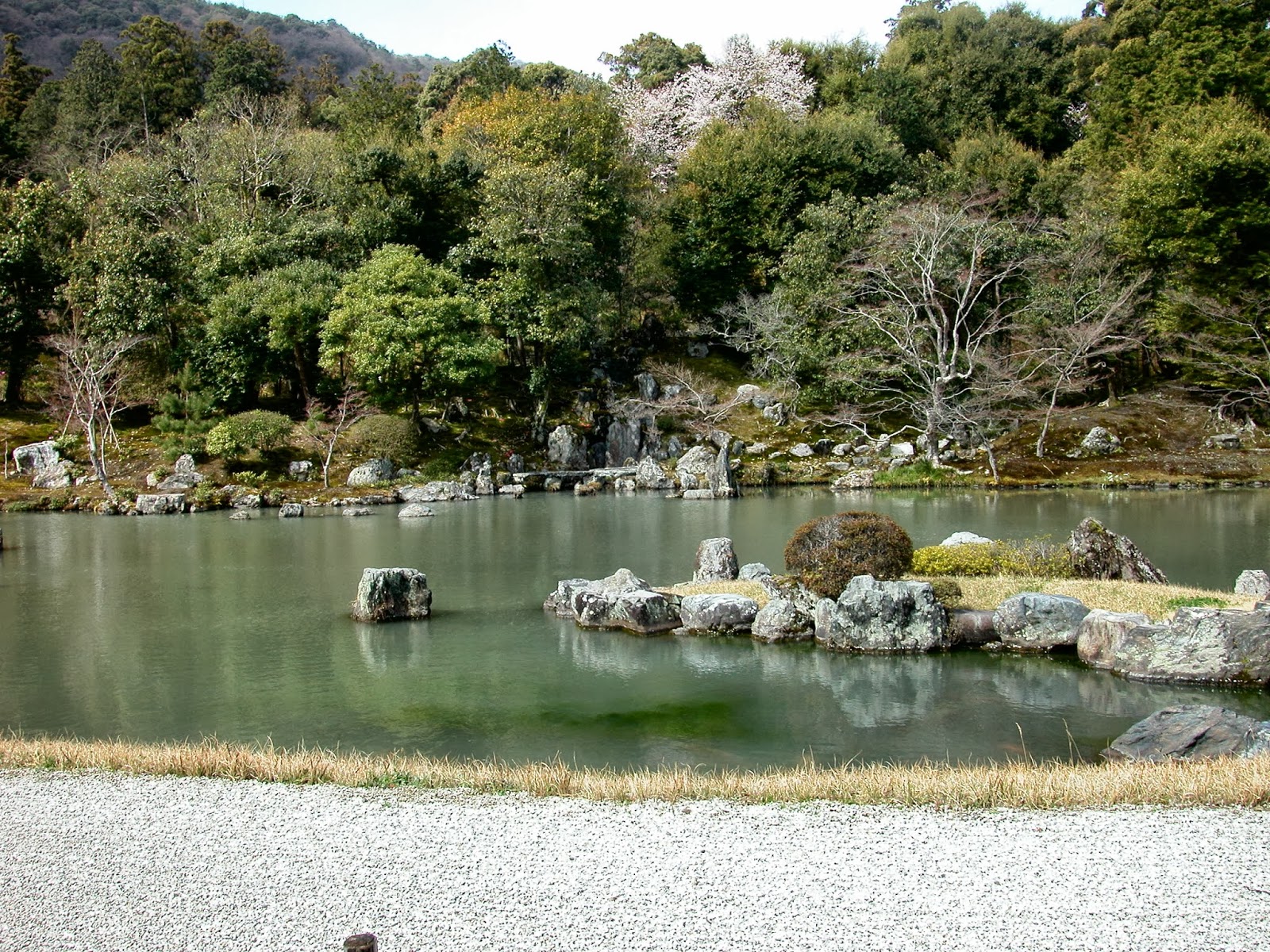
plane on towards the next. This is evident in looking at a garden such as at
the Tenryu-ji Hõjõ. The scenery unfolds sympathetically in respect of the
position of the viewer, enhancing the inclusion of the viewer as being part of
the scenery itself, not divorced from it. Looking at a painting or garden we
can then subliminally recognise ourselves as being part of the landscape, it
(the landscape) becomes an extension of our self. As landscape we stand surrounded
by all that is landscape.
 |
| Tenryu-ji, Kyoto |
We can deal with shakkei (借景) or ‘borrowed scenery’ here too. Shakkei is the incorporation of
elements of the landscape beyond the garden perimeter into part of the overall
composition which the garden represents. It is a device that the garden
creators would have seen used in paintings as a means of rendering far distance
and depth. All kinds of landscape features can be captured by some means of
framing them; the most frequently used ways are with architectural features
such as posts, with hedges, tree trunks or canopies pruned to allow specific
views through, or even the sky itself as used in Shugaku-in Rikyu. What is
‘borrowed’ will depend upon the specific location, it may be a single detail,
such as a temple roof, a mountain, or hillside or even a range of mountains.
Shakkei extends the boundaries of the garden potentially far beyond its
physical limitations, it also binds the garden with the surrounding landscape,
thereby enhancing the illusion of the garden scenery being an element of the
natural landscape itself.
 |
| Shugaku-in Rikyu, Kyoto |
Miegakure, or ‘hide and reveal’ is another
compositional technique that has been in long use in painting, and can also be
found to be employed in Far Eastern architecture. This can be seen in the
paintings where paths and rivers for example, appear and disappear in amongst
the landscape scenery. Miegakure
contributes to creating rhythm as well as enhancing the layering effect in a
composition too. It is yet another means by which the viewer is drawn into and
so can become engaged with the totality of the experience. In Japanese gardens
this is usually used in the setting out of paths. Paths do not have a direct
line, but will meander, opening and closing views to the viewer, offering
glimpses of scenery, then withdrawing the view, before representing a view from
a different perspective. The nature of the path itself will influence how a
view is revealed, for example by the use of stepping stones which tend to draw
the eyes downwards (so ‘closing’ a view), and then at some point the tension
will be relieved bt introducing a broad slab of stone as a resting point from
where a view is presented. Most often, miegakure is created by screening with planting, but land
shaping can be involved, as can walls or other architectural features. The use
of suggestion is a cornerstone of Japanese aesthetics, and miegakure fits with this way of thinking, it is well
illustrated in the writings of the Buddhist monk Kenkõ Yoshida (吉田 兼好 1283? – 1350?) who wrote “In everything, no matter what it
may be, uniformity is undesirable. Leaving something incomplete makes it
interesting, and gives one the feeling that there is room for growth.”
The point is that the whole is better revealed incrementally to the viewer, and
in so doing the whole experience becomes greater than the sum of its parts.
 |
| Okichi Sanso, Arashiyama |
To follow this blog:
the 'Follow by E-mail' facility is now operating.
Don't miss a beat and sign in.