Monday, 16 September 2013

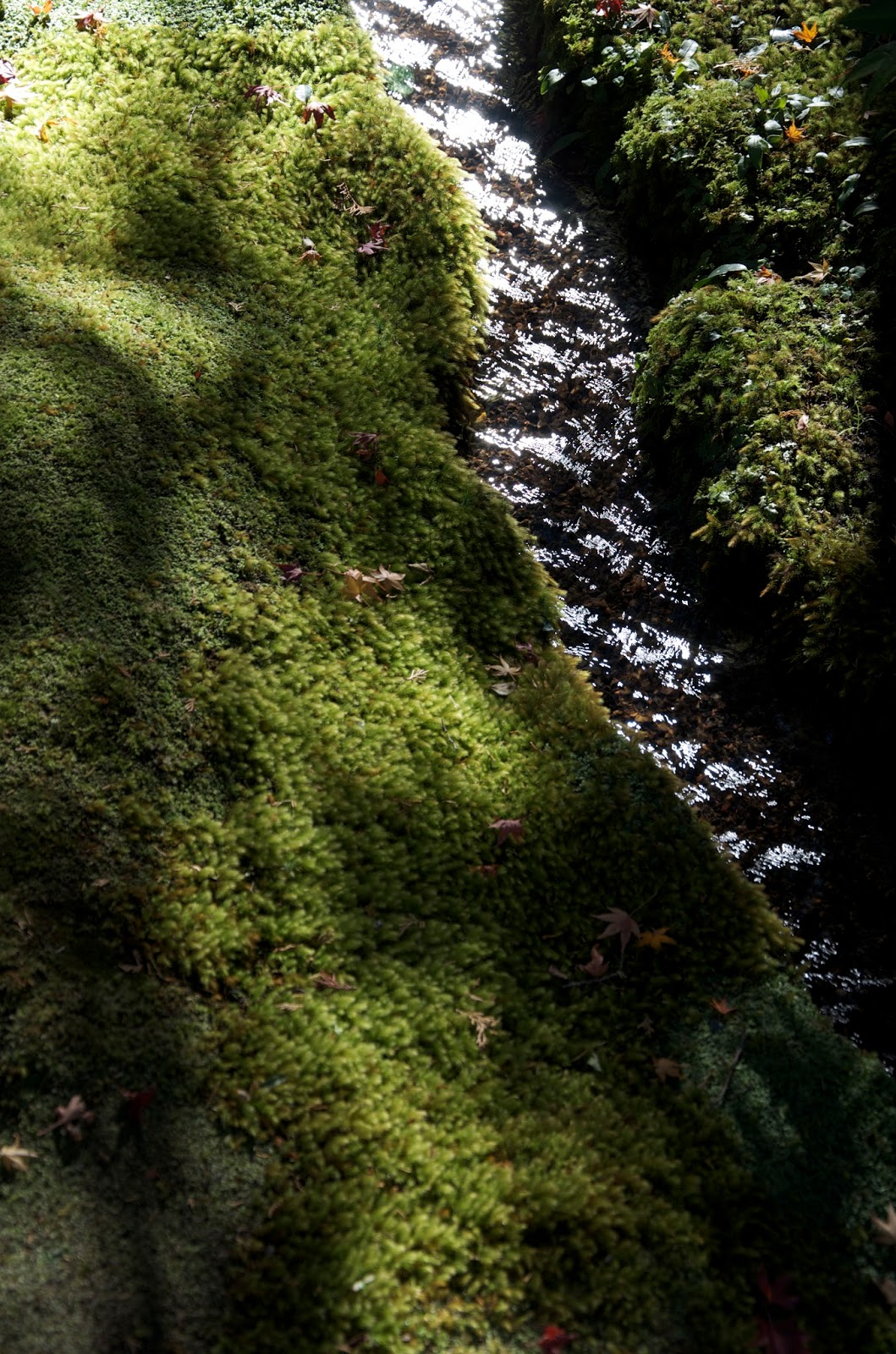
Light Cradling Gravity's Weight


It begins with pattering pinpricks of sound
Sudden and unexpected,
Before blending into a percussive flow–
Autumnal rain and the crab apple tree.


While sitting still
Thoughts rising and falling
As if a stream rushing from the source
Body held still, mind arising.


One glance, one realisation.
Just laying the foundation
For the next moment to unfold.


In no way held to fortune
Softening and blurring the edges
Of mind unfolding as mind –
The ringing bowl beginning and ending.


Seeking for solutions
Without the application of reason.
Just trusting the Universe to know itself –
Voices tumbling in dream cascade
As light cradles gravity’s weight.


To follow this blog: the 'Follow by E-mail' facility is now operating. Don't miss a beat and sign in.

Thursday, 12 September 2013

Bird World In Flow


Swaying for grip in the gusty wind
The magpie eyes me suspiciously,
What business have I in his world?
I throw him the evil eye before closing the door
 Softly.


Turning over the soil,
Work is work is pleasure too.
The robin waiting on impatient.


In a wildly unstructured dream:
A flock of crows rise congenially together
Twisting and rendering the air black with their cawing-
Searching for a name amid the weeds of the field.


Yet barely more than a speck,
Dwarfed by billowed clouds towers,
The kite holding station.


From somewhere amidst night’s secret flow
The call of the owl –
Tiny feet frozen earthbound.


To follow this blog: the 'Follow by E-mail' facility is now operating. Don't miss a beat and sign in.

Religious Thought and the Gardens of Japan. Part 2


The Use of Religious Symbolism

The Japanese garden has made great use of symbolism over a long period of time, and much of this symbolism is derived from religious sources. It is primarily intended to reinforce the sacred quality of the space itself, and also to direct the attention of the viewer. By identifying features within the garden through symbolic content, that is, by naming elements, one also seeks to impose order on an otherwise undifferentiated perception. The use of symbolism is also a means by which the garden space to communicates with the viewer. The garden is not a passive entity simply to be seen, but a space which engages the viewer, and the viewer becomes an element of the garden itself.

One of the most significant symbolic elements in the garden at the time was the placement of a feature known as Shumisen [1], or stone model of Mt Sumeru (or Meru). A shumisen was unearthed in 1902 in Asuka, near Nara, which was made up of three pieces and was carved with depictions of water and mountains, the likelihood is that it functioned as a water feature. Perhaps being sited in a prominent location in a garden space. It was certainly deemed important enough to have been noted in the historical record.
Shumisen excavated near Nara, some of the carving represents mountains
Mt. Meru is a mythic or cosmic mountain of great symbolic importance in classical Buddhism and signifies the axis mundi of the entire universe. Here the mountain signifies the ‘centre of the world’, as Eliade has remarked ‘the peak of the cosmic mountain is not only the highest point on earth, it is also the earth’s navel, the point where creation had it’s very beginning’[2]. Its presence seeks to establish the garden as a point of contact between the mundane and transcendental worlds, and in so doing confers and reinforces moral, spiritual, even political authority on the persons most intimately associated with the garden itself. Even to this day one finds stones set in gardens representing Mt Meru or Shumisen, which underlines the continuity of symbolic expression in the Japanese garden into the modern era.
The tall stone of the 16th C arrangement is usually referred to as a Shumisen stone. Ryogen-in, Kyoto
The combination of the entrenchment and a continuing development of Buddhism in Japanese life, along with the establishment of a new site for the capital in 794 AD at Kyoto, was to lead to the emergence of the garden tradition as a fully fledged entity, where garden making could be a vehicle for expression of profound and complex ideas. In Japan, the garden was not solely a series of decorative features to enhance the outlook of domestic or public spaces; it was (and is still) also intended to be illuminative and inspirational. Entering the garden space, the viewer enters into a ‘dialogue’ with the garden. In this largely unconscious exchange, the viewer both enters the garden space and the garden occupies the imagination of the viewer. Thus the viewer is not a passive element of exchange, rather he or she becomes an active participant in a creative force. The garden becomes a ‘field of dreams’, yet also a proving ground for the emergence of consciousness into differing levels of reality to the simply mundane or everyday world of perception.
Miroku Bosatsu. Kōryū-ji temple, Kyoto
In the early 9th century two new schools of Buddhism were introduced into Japan by Japanese priests who had made the perilous journey to China in order to gain new knowledge. In 805 the Tendai sect was established by Saichō (767-822) based around the Tiantai tradition he studied during a visit to various centres of learning in China beginning in 804. Saichō founded as his headquarters Enraku-ji temple on the summit of Mt. Hiei to the north-east corner of the city of Kyoto, and he is also credited with being one of the first people to bring tea seeds to Japan. A year later the scholar-priest Kūkai, who had originally also traveled with the same embassy to China as Saichō, was to establish the Shingon sect on Mt Kōya to the south of Osaka following a dream. Among the new ideas these men brought back was the concept of the mandala drawing (concentric diagrams that may be used to focus attention in order to establish a notion and awareness of sacred space, and also as an aid to meditation and trance induction). The psychologist Carl Jung regarded mandala as being a representation the unconscious self, a map of one’s inner being, and as such the mandala symbolically can be read as a microcosm of the Universe. In this way, the layout of the temple complex (the buildings and its landscaped gardens) after the form of a mandala is a way of establishing the physical, psychological and spiritual dimensions of space itself. Thereby all the elements set out within the delineated boundaries will assume a meaning charged with particular potency.
Shingon mandala
Thus we can see that the spiritual path (of whatever denomination) is a means by which mankind attempts to recognise and order the world he lives in. Beyond this is also a tacit recognition that all that appears before our eyes is but part of the truth that unfolds before us. In Buddhism the natural landscape has always occupied a special place, after all it was whilst meditating under a Bodhi tree (ficus religiosa), that Shakyamuni Buddha achieved a state of enlightenment. One of the core tenets of Buddhism is the goal of the eventual enlightenment of all sentient beings, and there has been historically a debate in Buddhist circles over what precisely is intended by the expression ‘sentient beings’. Is it intended to be taken literally, that is, only beings capable of independent awareness are capable of enlightenment? Saichō for one, wrote of rocks and trees equally being able to achieve enlightenment, and there are many other commentators who have set out an opinion that all beings and all things have the potential to exist in harmony with the Universe. Buddhism in Japan reflects the concerns and sensitivities of native religious thought concerning the environment. It was well placed to do so, as the Buddhist thinking that was brought into Japan, particularly from mainland China, was intimately concerned with the landscape. The landscape was seen and appreciated as being a location where an enlightened soul can recognise his essential oneness with the greater environment in which he exists. This notion of non-duality is one of the most fundamental concepts in Buddhism, and it expresses a clear belief in the interconnectivity and interdependence of all things. Delusion (that is separation from the ultimate truth) begins when man perceives he is separate (that is, in a dualistic condition) from the natural world he lives in.

Dogen (1200- 1253) who founded the Soto Zen sect of Japanese Zen, wrote an important text, Sansuikyo (‘Mountains and Water Sutra’)[3], within which he states: “The mountains and waters of this moment are the actualisation of the way of the ancient Buddhas. Each, abiding in its own phenomenal expression, realises completeness. Because mountains and waters have been active since before the eon of emptiness, they are alive at this moment. Because they have been the self since before form arose, they are liberated and realised.”  He goes on to remark, “Because mountains are high and broad, the way of riding the clouds is always reached in the mountains; the inconceivable power of soaring in the wind comes freely from the mountains.” With these two comments Dogen seems to neatly encapsulate the Sino-Japanese perception of landscape. In the first comment, he establishes the potential for landscape to exist in a condition of absoluteness, and in the second, he shows the way the spiritual aspirant can realise enlightenment in that environment.
Landscape Mt Koya area

The essence of any search for meaning is to create order out of what appears to be unformed or chaotic. Landscape too is a mundane manifestation of a series of dynamic and highly complex events which in origin were non spatial. Forces of inexplicable power and force are liberated to unfold as forms, which then gradually disclose in themselves the quantitative order of their inner tensions. Everything changes in Nature, nothing remains static, one season morphs into the next, night follows day, which follows night. Everything is in a constant process of change and transformation. The expression of movement in the garden is a vital recognition of the forces of Nature. The merest glance or cursory experience of the Japanese garden reveals this, what appears to be still and unmoving, actually expresses movement, transformation and energy. Recognising the essential quality of movement and regeneration in Nature, and hence reflecting that in the garden, creates space for the viewer to become a part of that continuum. The symbolic content employed as part of the language of garden simply sets out further ways that the imagination of the viewer may engage with the garden.

Landscape at Kurama dera, north Kyoto

The Japanese garden is landscape itself, landscape distilled to a creative essence, and concentrated in a form that can exist within the delineation of a domestic space. Landscape as seen and selected by an automatic response of the unconscious, which detects in it an affinity that gives one pause and allows us to return to it time and time again. This then is a question not of a projection but of analogy whereby the landscape is adopted by the spirit in consequence of an inner bond linking the character of the scene with the spirit of the observer himself. Subjectivism might occur, but only in the act of choosing one particular style of landscape over another. The evocation of symbolism shows us how we absorb the experience of an objective force and then render meaning from the experience. Recreating the object by filtering it through our conscious imagining. Signs and symbols allow us to engage or participate – thus we can become a part of the fabric of what is being created within us through our imagination. The duality between being ‘here’, and the garden being somehow separate or outside of ourselves (‘there’) is eroded and ultimately dissolved. When that process occurs we may begin to recognise our role as an active participant in a continuous and ongoing process of recognition, realisation and reconstitution.
Landscape garden, Korin-in, Kyoto
The symbolism and language of the garden is rooted in the recognition of the garden as representing, indeed, recreating Paradise, there has been a consistency of expression of this ideal in Japan from the earliest attempts at garden making right through to the present day. The language of the garden is one that is derived from the natural landscape, perhaps it is through the profound interpenetration of the garden culture by religious notions which has preserved this consistency of thought. The gardens may have developed a variety of forms, but the underlying concerns have remained consistent through time. The perception of the garden, fuelled as it is by the accumulation of cultural memory and imagination, is one whereby man can recognise his essential self, as an active participant in an ongoing process of change and continuity.


[1] Mentioned in an entry for 612 AD of the Nihon Shoki, that a Shumisen was created by a Korean craftsman in a garden created for Empress Suiko.
[2] ‘The Sacred and the Profane’. Mircea Eliade, 1957.
[3] Contained within Dogen’s principal work, ‘Treasury of the Eye of the True Dharma’. Translation by Arnold Kotler and Kazuaki Tanahashi. Dharma Rain (Sources of Buddhist Environmentalism), ed. Kaza and Kraft. Shambala Press, 2000.


To follow this blog: the 'Follow by E-mail' facility is now operating. Don't miss a beat and sign in.

Wednesday, 11 September 2013

Religious Thought and the Gardens of Japan. Part 1

Water, light and plants
All cultures that have developed a tradition of the creation of gardens, can trace the origin of such garden making back to a source idea of the re-creation of Paradise, or a paradisial state of being. The notion of ‘Paradise’ is a symbolic projection onto the material world of an ‘inner state of being’, which is both idealistic in scope and ambition. The connection between the notion of the garden as representing Paradise and human society is perhaps as old as human culture itself. This is just as relevant to Japan, as it is to any other culture where gardens have been created. The idea of Paradise underlies the notion of the garden is as pertinent today as it has been at any time in the history of human culture. One may even argue that in this modern age it is even more pressingly relevant than it has ever been.

The garden corresponds to the idea of the temenos, or a sacred circumscribed space because it is understood to constitute a spiritual entity; whole and complete within itself. In Japan, perhaps more than anywhere else, religion (as a formalisation of the idea of spirituality in society) has had a profound influence on the development of the garden culture that has emerged over more than 1500 years of development. Indeed, it is in the grounds of Buddhist temple complexes that the most distinctive gardens, which we may associate with Japan appear. The karesansui, or ‘dry landscape’, gardens, which are such a characteristic of Zen temples, may have been an idea that emerged originally in China; but it is in Japan (at the Kyoto Five Mountain Zen temples in particular) that this form of garden was to develop into the distinctive art form that we know today. All gardens are obviously subject to influence from social and economic forces, as gardens are after all, a mirror of social and political aspirations. What one may detect though in Japan is a continuity and a cohesiveness in the influence that the primary religious forces were to bring to the gardens.
Kibune Shrine, north of Kyoto, the stones encircle a Sakaki tree. This evocation of sacred space was the work of the garden creator Shigemori Mirei and was constructed in the mid 20th C
When we speak of the influence of religions on Japanese gardens, there are three principal threads, Buddhism, Shinto and Shamanism. Further, one can also find further traces of elements of religious influence from continental China, namely Taoism, and Confucianism. It is important to understand that when we speak of the influence of these various religions on the gardens, it is not simply a question of the influence of religious practice on the physical forms of the garden, but perhaps even more crucially, what religious or spiritual thought and awareness was to bring to the perception of landscape as a whole. In both Japan and China, the gardens are intimately associated with the landscape; indeed, the gardens were to develop into a synthesis, a distillation, of the very notion of landscape itself.

Before examining in more detail the role of the various strands of influence of religion on the Japanese garden culture it is worth pointing out the notable eclecticism in Japanese thought in these matters. Buddhism, which was officially introduced to Japan in 552 AD, was integrated into an already existing complex set of native beliefs rather than superseding them. It is perhaps partly a reflection of the character of the Japanese people of the time that this was done without overt conflict. Where disagreements occurred it was more due to political interests and competition for influence, rather than due to any profound sense of doctrinal conflict. Buddhism by its very nature is an essentially syncretic religion, and sought to adopt and embrace the native forms of religious belief.

Mountains and Water
Huangshan Mts. Anhui Province, China
Shamanistic practices probably arrived in Japan with the very first settlers to reach and explore the islands, and shamanism has lingered as an undercurrent of spiritual belief in Japan right up into the modern era. Both Shinto (which is generally held to be the native religion of Japan, and likely actually developed out of shamanistic origins) and Shamanism share a number of characteristics that have a bearing on perception of the garden culture. Principal among these is an intimate connection inherent in both practices toward nature and elements of the natural landscape itself, as it was in the landscape that ceremonies and rites were practiced. It should be noted that the term for ‘landscape’ in Japanese, sansui, is composed of two characters san, indicating mountain, and sui, indicating water. In this way the entire complexity of the concept of landscape can be reduced to the interaction of these two most fundamental elements, as well as underscoring the importance of both concepts to gardens.

In Shinto, kami (usually translated as ‘gods’ or ‘sacred spirits) are worshiped. Among the objects or phenomena designated as kami are the qualities of growth, fertility and production; natural phenomena, such as wind and thunder; natural objects, such as the sun, mountains, rivers, trees and rocks, as well as certain animals and also ancestral spirits. Much the same can be applied to Shamanism too, whereby many of the same phenomena are regarded as being potentially sacred. For example, trees and rocks are of particular importance as they were held to be the abode of sacred spirits. In this context these elements are charged with a profound spiritual resonance.
Ancient cherry encircled by a rice straw rope designating the tree as being an abode of kami
One of the prime characteristics of the Japanese garden is in its use of stones, particularly in the manner of setting upright stones as principal features in the layout of the garden. The setting of stones is regarded a crucial measure of the skill and sensitivity of the garden creator, and the arrangement of the stones (ishigumi) is seen as being the very skeleton of the garden itself. The prominent siting of garden stones emphasises their importance, and in the garden context stones are usually to be read as representing mountains.
Zuiho-in, Kyoto, the powerful rock arrangement represents Mt Shumisen

Mountains, given their physical vastness, the difficulty of access, inspire reverence and adoration, and sacred mountains are found in virtually all cultures across the world. In Japan there has been a very long established practice of mountain worship. Mountains were revered for their shape, as in conically shaped dormant volcanoes such as, Mt. Fuji (also national symbol), Mt. Chõkai, Mt. Taisen (both in Honshu) and Mt. Kaimon (Kyushu). Mountains were also worshiped as being watersheds or sources of streams (these sacred waters are known as harae-gawa, ‘rivers of purification’), a connection that was particularly important for an agrarian society. Thirdly, mountains were closely connected with ancestral worship, as it was believed that mountains were a point of transition between this world and the afterlife. Mountains have been at the heart of the sacro-religious life in Japan since the earliest times, and every religion established there has developed its own connections and symbolic associations with mountains.

Given the importance of mountains in Japanese religious life, one can begin to understand that stones representing mountains in the garden context will assume a depth of meaning that goes far beyond merely ‘placing rocks’. Stones can become infused with significance, symbolism and will be resonant with meaning to the knowing. They become manifestations of the sacred themselves, or hierophanies[1]. Stones (and other elements deemed as heirophanies) are not revered for simply being stones, but for what they are perceived to express and to contain. Contained within the world view of both Shamanism and Shinto, the landscape is seen and interacted with as a living being, which supports the local population both materially and spiritually.

Water is a most primal and a fundamental element that allows life on earth to exist. In Shinto water is understood to act as a purifying agent (a notion that underpins a prime role of Shinto itself. Entering a shrine a worshippers will rinse both their hands and mouth before proceeding to offer prayers to the deities. The same practice is undertaken in the Tea garden (chaniwa), where participants to a tea ceremony would expect to make the same ritual ablution at a tsukubai, or crouching basin, before entering the teahouse. In Chinese traditional belief, bodies of water were the abode of dragons, whilst the mythology of dragons is exceedingly complex in China, an important point lies in the belief that dragons acted an intermediary between heaven and earth (hence also often associated with rain). Much the same ideas are held in Japan too, where dragons are regarded as water benevolent deities associated with good fortune and the benevolence of heaven being bestowed onto the earth. Dragons are often evoked in temple names, such as in two notable Kyoto temples, both sites of historically significant gardens: Tenryū-ji 天龍寺 ‘Heavenly Dragon Temple’, and Ryōan-ji 竜安寺 ‘Dragon Peace Temple’.
Dragon and Tiger representing yin and yang energies. Fusuma painting Manshu-in,  Kyoto.

Prior to the official adoption of Buddhism in Japan around the mid 6th century AD, there already had been considerable effort put into creating agricultural and ritual landscapes. With the introduction of rice growing culture by 300 BC[2] people would have learned to modify the landscape to make such cultivation possible, and land would have been cleared and levelled and water flows controlled. During the Kofun period (250-552 AD), ritual landscapes were being created primarily around large stone lined tombs covered by substantial earth mounds and the mounds themselves were surrounded by ponds. Also in the Nihon Shoki[3] it is noted that hunting parks had been established by the late 6th century AD after the Chinese model for the use of the Imperial family, though these may have been more in the way of exclusive land preserves set aside for Imperial usage.
Islands in the pond of Kinkaku-ji, Kyoto
This then was the environment to which Buddhism into Japan in the mid 6th century, initially through the medium of Chinese and Korean priests and craftsmen. The earliest attempts at creating gardens proper in Japan were attempts to recreate the idea of landscape as a sacred entity, albeit in a form that could be modified to suit a more ‘domestic’ situation. These forms of gardens in Japan (initially created for Imperial residences, and then in the grounds of properties of members of the aristocracy closely associated with the Imperial lineage) were of the ‘pond and island’ model. The word used for gardens at this stage was shima (island), which indicates something of the importance (and novelty) of this type of garden. Within the gardens, elements such as stones would have been erected and no doubt given particular symbolic importance. From other sources, such as the Sakuteiki [4], we can understand the gardens that developed were generally modelled after the conception of the creation of varying types of landscapes, nearly all of which would have had ponds and islands in them. These early gardens were created specifically with the idea of creating an environment that would prove attractive to various deities being addressed. Gardens were being created that could satisfy a dual purpose; on the one hand, the gardens provided aesthetic pleasure through their link with Nature, and then again the gardens, in their semi-public role as a stage for ceremony, also acted as a bridge, or point of transition between the secular and spiritual worlds. One should point out that in Japanese conception, there is a seamless transition between these two functions.


[1] A term coined by Eliade. ‘The Sacred and the Profane’. Mircea Eliade, 1957.
[2] For a long time the earliest evidence of rice farming was dated to around 300 B.C. which fitted into models that it was introduced when the Koreans, forced to migrate by upheaval in China during the Warring States Period (403-221 B.C.), arrived in Japan at around the same time. Later a number of Korean objects, dated between 800 and 600 B.C., were found. These discoveries upset the neatness of the model. Then in the early 2000s, grains of wetland rice were found in pottery from northern Kyushu dated to 1000 B.C. This called into question the dating of the entire Yayoi period and caused some archeologists to speculate that maybe wet-land rice farming was introduced directly from China.

[3] The Chronicles of Japan, an official history complied by 720 AD

[4] Sakuteiki – ‘Book of Garden Making’, the oldest treatise on garden creation written mid to late 11th C. Takei and Keane. Tuttle 2001.


Part 2 of this post will follow shortly.

To follow this blog: the 'Follow by E-mail' facility is now operating. Don't miss a beat and sign in.

Sunday, 8 September 2013

Cool Breezes


Where the shifts to break the glass?
The heart bound yet diamond still
Caught amidst a web of dreamed desire –
Shuffling steps to find the wisdom.


Time carries no gift of redemption
Nor a path to reset the compass -
Learning the hard way
Nothing may be undone-
Cool breezes herald autumn's cusp.


The sanctuary of the other shore
Beckons in the fading light of day.
Rolling amidst the thunder
The scrape of the lighthouse keeper’s boots,
Steel on rock, the seabird’s white cry.


It must be so,
There is no other way.
These my pleadings of ignorance
Of petals scattered amongst tall grasses.


The mind looking in at the mind
And heart searching for its equivalence,
All in reply to an unbroken need to create
And to fashion a re-membering of the world-
Drawing past and futures toward the light.


To follow this blog: the 'Follow by E-mail' facility is now operating. Don't miss a beat and sign in

Saturday, 7 September 2013

Rain Moistening Dry Earth


This hand that moves
This eye that sees
This tongue that tastes
This ear that hears –
What comes before?


In which sense
The Beauty of mind?
As soft rain moistens dry earth.


Slipping between waves
Rising on a spiral
Boring deep into earth core –
Trying to find the key
To unlock love's eternal mysteries.


Sitting quiet
As the candle flickers
And incense coils.
The empty cushion beside me
Holding presence without form.


A time of tides
A time of shifting seasons
A time to accept the gifts of being -
Picking sweet sour blackberries by the canal.


To follow this blog: the 'Follow by E-mail' facility is now operating. Don't miss a beat and sign in.

Wednesday, 4 September 2013

Oceans Of Possibility


Oh sweet memory,
Gilding the experience of being.
Soft I turn form that has no form
In hands that girdle whole worlds.
Illuminated by light and the act of loving,
 Air itself.


Passing this way and that
Where do boundaries lie
Who defines what?
The mystery.


You shared dreams and desires
A stream of words
A river of being
An ocean of possibility.
So swim
Be free.


Allowing flow to flow
That is all I can offer,
For I have no sense of possession
Nor desire to constrain.
The river runs to the ocean
To be reborn.


Lying under the tree
Gazing upward into the crown,
Each leaf has its place,
Catching the light.
When summer turns to autumn
Then autumn spirals to winter
And winter unfolds itself into spring.
Again.


To follow this blog: the 'Follow by E-mail' facility is now operating. Don't miss a beat and sign in.

Hakaze-an; Tea Pavilion Project Part 2


The building is beginning now to take on a life of its own, beginning to express character, and claiming space as its own. Standing inside the open space, with the thick beams of Western Red Cedar that hold the roof structure aloft, the building feels rooted in the ground, and the sheltering roof provides a sense of sanctuary and enclosure. You feel as if you are being held here, nurtured even. Its an emergent sense, still but a whispering in the breeze. But it is there if one listens with the whole of the body. Buildings and gardens can become extensions of our body, indeed if they are to function to their highest level, then they must strive to do just that. We do not just absorb the experience of the building or garden through our visual sense, but with our whole being.


As Juhani Pallasmaa expresses it in 'The Eyes Of The Skin': "We feel pleasure and protection when the body discovers its resonance in space. When experiencing a structure, we unconsciously mimic its configuration with our bones and muscles..... Architecture strengthens the experience of vertical dimension of the world. At the same time as making us aware of the depth of the earth, it makes us dream of levitation and flight." Its a fascinating process to see that unfold in time. Part of one wants impatiently to rush to the conclusion, the unveiling of the complete, yet the awareness is there that in the process of unveiling the real relationship is revealed. We come to know the space created, and the space begins to know us.


All creative process are an exercise in balancing the sense of will generated by the ego ('I want it to be like this'), with the recognition that we need also to 'allow' the building or garden to emerge of itself. The creative spark, the idea that sets the process of unfolding in motion, is filtered through the hands and experience of the craftsman builder. Then when we remain still and centred, something quite magical happens, the project begins to assert itself. 'I need to be in this shape, I need to take on this form'. The result is a collaboration between the maker and the made, and if the subtle voices are heard, then there becomes no difference between the two. The one becomes the other.


Each detail of how the viewer will experience the building needs to be considered. How the building will be approached, entered, experienced, and how will the interior reveal the exterior, all these things need to be considered. The main area of occupation within the building, the 'area of sanctuary' is orientated towards the south, to allow the maximum amount of light to open up the space enclosed by the structure. This allows us to create a lower light level in the entry zone. The point of this is to make the act of entering the building a graduated experience, the viewer will move from open space into a relatively confined space with a lower light level, then transit within the building towards the light and comfort of sanctuary. The internal walls divide up the space to enhance the sense of transition. The visitor will have to turn to the left on entering, step up onto a raised floor, and then turn right, and step down into the main area. On entering and turning left a low opening will allow a glimpse of garden space which the building both hides and reveals. The walls are to be rendered in lime plaster, in itself a material that 'breathes. The render is applied in two coats, the top coat, a lime wash, will carry a colouring agent to compliment the exposed timbers of the structure.


Hakaze-an, the 'Hermitage of the Breeze From A Wing' is beginning to reveal itself.


Project Manager/Designer: Robert Ketchell
Architectural Consultant: Andrew Broughton-Tompkins
Master Builder: Andrew Ninnis


To follow this blog: the 'Follow by E-mail' facility is now operating. Don't miss a beat and sign in.