Monday, 21 April 2014

Mist Soaked Memory

These, the mountains I see
Are not near hills and peaks,
But the Eastern Mountains.
A mist sodden image I have
Dredged from distant layers,
Cellular memory, even.


When pain wracked
And digestion
Churning in tempest,
Nothing other exists
Yet the patience to be stronger –
A distant river penetrates the trees.


The cry of the curlew
Arching through the hills -
Chasing our steps up the valley.


Now the city a refuge
Somewhere to hole up,
Let flesh mend and mind settle.
Water in the glass untouched.


And you,
waiting
To come into this world,
Any day now they say –
Waiting
To take your very first breath.


To follow this blog: the 'Follow by E-mail' facility is now operating. Don't miss a beat and sign in.

Thursday, 17 April 2014

A Share Of Breath


Space too,
Requiring a voice
A shape to be said, thought, & sung.
To know a share of the breath
In flow.


I squeeze you
Tight as possible
Without breaking something,
In order to release
Juiciness & the fire.
Each word
Each vowel, syllable,
A perturbation
Across the mirrored mind.
Searching for utter immersion.


Just wind enough
To fractal the skin.
Slowing the heart’ eye
To see again.


To speak of surface and depth
Is mis-understanding.
When the inside is the outside
And the in-breath

The out.


To follow this blog: the 'Follow by E-mail' facility is now operating. Don't miss a beat and sign in.

Tuesday, 15 April 2014

Atmosphere and Perception in the Japanese Garden


Daichi-ji, Shiga Prefecture, Japan
I paid my entry fee at the temple entrance and walked the length of a dim corridor with a soft shuffle of shoeless feet. Turning a corner into the light I suddenly realised I was in a landscape. A landscape like no other. I knew I had arrived.

Shutlingsloe Hill, Cheshire, England
Atmosphere in a garden of any description is a quality we may experience, and something we invariably cherish deeply. The gardens of Japan itself and in 'japanese-style' gardens in many instances outside of Japan, are laden with the quality of atmosphere. It hangs in the air as if a breeze laden with scent. We are 'overwhelmed' by the shock of it all. It stays embedded in our memory, as if it has permeated our flesh and bone. To any garden lover a visit to Japan is a life enhancing experience, life changing even. 

Landscape in the palm of your hand
As human beings we cannot exist outside of our connection with Nature, and by extension, the landscape that is the flesh and bones of what Nature is. Even after we bury nature and wildness under a dense carpet of urban sprawl and development; taming wildness to create a space where we may 'live', we continue to vibrate with the natural world. Creating a garden, of any hue or style, is an attempt to reconnect that energy that floods through our being. A garden is never 'wildness', a garden is ordered, organised and above all crafted by our endeavours. Part vision, part perspiration.

Stone river flowing
 The atmosphere, the scent of a garden, the invisible which makes the visible 'real', is the quality of being transported and so altered by that which we experience through all our senses. Every thing that exists radiates a field of electromagnetic energy, every part of a thing transmits energy into the Universe. The rock carries the history of everything that has ever been, as does each crystalline part of its structure, every molecule, every atom. Each has its own memory, own story, its own song. The same for the tree, the shrub, air and space, water flowing or still. In creating a garden the garden creator attempts to channel those very energies; filtering imagination through intention to create a certain quality of space, a certain quality of atmosphere to be inhaled by the viewer, the one who experiences. The garden creator assumes the role of conductor seeking, however momentarily, to conduct and shape the very flow he or she is a part of. Nature can never be entirely consumed nor controlled, for to do so would be to consume ourselves. 

Atmosphere arises in infinite forms. Passing as if vapours within and beyond our conscious awareness. We are affected by it all. An infinity of potential, of memory, an infinity of songs of being. By its very composition and existence the garden is always changing, moment by moment, season to season. In the Kyoto gardens of the Heian period (794-1185) the aristocracy savoured the fragility of life in the passing of the seasons, in the brief glory of cherry blossom before the tears of fallen petals coat the ground in a flurry of 'snow-drift'. For the courtiers and nobility the recognition and interpretation of atmosphere through perception was known as mono no aware, the 'pathos of all things'.

Spring 'snow' carpeting moss

In the Japanese garden the creative perception of the garden creator is governed by intention and awareness. It is this that is strived for through practice. Seeing the flowing in the static, and the staid in the flowing. The constant movements through time and space, the flow of everything. As electromagnetic fields come together they synchronise and so interpenetrate; they become one dance. The rock and the petal together in one movement. The viewer becomes part of the fabric of the garden, and the garden an extension, a mirror of the viewer. In a space bounded only by linear consciousness, the heart perceives and knows the infinity of existence, feels the constant ebb and flow. The garden acts as a prism bringing sharply into focus the awareness of landscape, mountains and water. The interconnectivity of it all.

Harmony is never static, but in ceaseless change. The gardener a servant of the garden, much as its master. In change the heart perceives harmony. In the awareness of flow comes peace, because in becoming whole we recognise our place. The garden through atmosphere and perception becomes greater than the sum of its parts. The language of the song with which it sings is Beauty. The colour of Beauty is emotion, so we are nudged or shocked into dancing with ourselves mirrored in the garden's gaze. 


"Life as a whole expresses itself as a force that is not to be contained within any one part." 

Goethe


To follow this blog: the 'Follow by E-mail' facility is now operating. Don't miss a beat and sign in.

If you enjoyed this, or any other post, please let me know! If there are specific aspects of the Japanese garden tradition you are interested in, please let me know. Thanks.

Saturday, 12 April 2014

Hakaze-an: Tea Pavillion, part 4


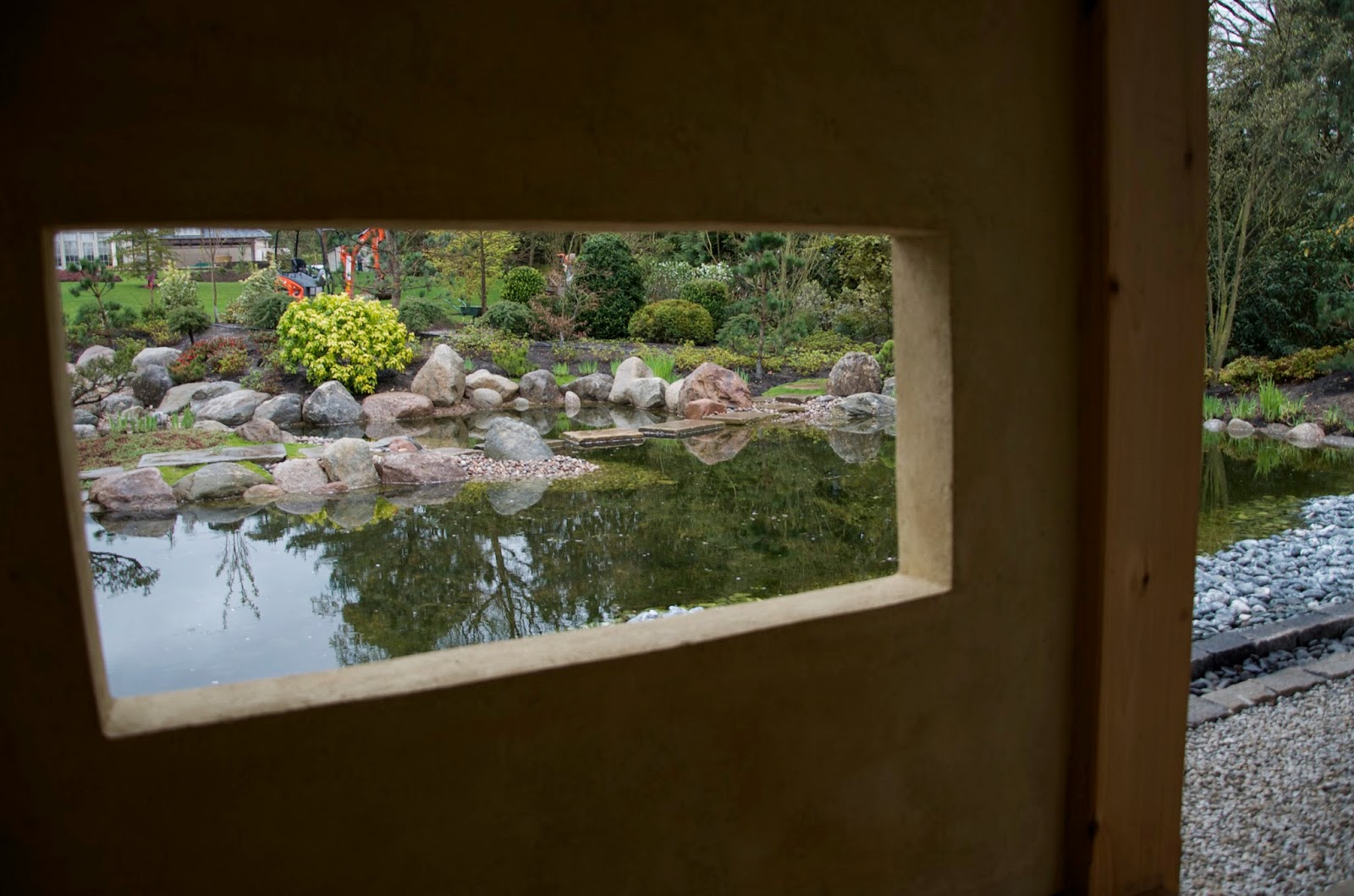
The project of creating the tea pavilion Hakaze-an and its garden has almost reached its conclusion. Though it should be noted that its highly questionable that a garden is ever 'finished'. A state of being 'finished' or 'completed' implies a that the form has reached its culmination and can only collapse in on itself or alter into something other. The plain fact is that gardens are never truly completed and certainly never finished, in the sense of arriving at the end of a piece of string. A garden is an infinite journey. It is something like riding a unicyle, a process of constant adjustment and readjustment to the various forces arising from within and being applied from the environment without. The garden we see and acknowledge probably represents about 85% of the effort and materials brought together in its creation. What we see is simply the skin of the garden. What we respond to is the beating heart of the garden


With this garden project what we have tried to do is to find ways of using and expressing ideas and approaches that arise in the Japanese garden tradition, and to find ways of interpreting and expressing them in a way that holds true more to the interior spirit than the external form. Prime among the concerns that have underscored the whole creative process has been to recognise and consider the interaction of the viewer and the garden. How will the garden be revealed and seen? How does the presence of the viewer alter the garden? How does the garden in turn shape and transform the viewer?  The very qualities of space, the sensory flavours of experience evoked by the garden and building become more hugely important.

It came very clear early in the process of creation that the space contained the seeds of its own creation. That is to say it was not always a question of the 'designer' seeking to impose his/her will on the garden and building to conform to preconceived notions and expectations. Rather it became a process of cooperation with the space itself. Guiding the project primarily involved holding the initial intention. The intention in this case was to create a space that held the qualities of harmony, calmness and sincerity. The ego can mask true intention of purpose, hence it is important that the ego is contained. The questions to ask are "what does the garden itself desire?", "what does the garden need to be able to express itself?" When you remain quiet within yourself then the answers can be heard loudly and clearly. Every garden project becomes a journey of discovery in itself. The creator is re-created by the creation. Every garden project becomes a journey of discovery in itself. The creator is re-created by the creation.


In keeping with the Japanese garden tradition much of the planting is evergreen, particularly the shrub planting which forms the principal volume of planting in the garden. There is quite a lot of tree planting, several varieties of cherry trees (Prunus species) for spring blossom, dogwoods (Cornus spp.), maples (Acer spp.) are the principal deciduous trees, as well as a number of coniferous trees (Pinus, Cedrus and Abies). The trees give height to the structure of the garden, and their growth will require careful monitoring and pruning so that their shape and volume is in proportion to the overall form of the garden. Amongst the planting are several specimens intended to create specific focal points in the garden. An example of this is the large cloud pruned pine that sits on the island. This tree which was obtained from a bonsai specialist is over 70 years old. 

In most contemporary gardens in Japan the palette of planting is quite limited. Western gardens, particularly English gardens, tend to utilise a greater range of planting. In the garden of Hakaze-an the understory planting of shrubs and herbaceous material has been planted in groups or drifts. The intention was to mass the planting volumes into coherent forms that will give the impression of flow and movement. Large quantities of Box (Buxus sempervirens) have also been used with the intention of developing them into clipped forms. The planting is intended overall to create both forms but another important consideration is the variety of textural effects that enrich the visual sensory experience.  

The island with its bonsai pine

The cascade is set toward one corner of the pons, it provides a variety of gentle sounds


To follow this blog: the 'Follow by E-mail' facility is now operating. Don't miss a beat and sign in.