The journey of learning how to create Japanese style gardens
has fascinated me for 35 years and counting. Over this time my perception and
awareness of what I am trying to create has shifted and evolved; the way I see
a garden now is quite different to what I saw then. How different the
perception of the Japanese gardener and a more horticultural orientated
gardener. In the West, the garden tradition leans heavily on the idea of the
garden as a place of display of plants. The average back garden is a home to
species from a variety of geographical areas of the world. The measure of a
Western gardener is his or her plant knowledge, and the ability to create the
‘right conditions’ for such a cornucopia. The skill and insight of a Japanese
gardener is judged by his skill with arranging stones and the sculpting of
plant material, typically trees such as pines.
 |
| Ryoan-ji, Kyoto |
The first garden I ever set eyes on in Japan was Ryoan-ji. I
have never been the same since. Sitting contemplating this apparently simple arrangement
of stones, wall and gravel, must have moved something in my soul. All gardens
are derived from the notion of the garden representing paradise. In this sense
of the garden being an expression of a state of grace, of being in harmony with,
in utter union with, the world about us. All the efforts, dreams and desires of
the gardener of whatever tradition, are to reconnect with that state of union.
Creating gardens is, in my opinion, capable of being an art form of the highest
order. The apparent simplicity hides a deep complexity ranging across time and
space. The gardener works with the most elemental of forces, earth, air, fire
and water. The gardener is part alchemist and part trickster figure. The
gardener conjures an illusion, a shimmering curtain waved before our eyes, and
we can believe in the dream, the illusion.
In the first instance I wanted to know, ‘how do these
gardens work here in Japan?’ ‘Why do they seem to have this atmosphere, this
particular quality to be so engrossing?’ You look at the rocks, the plantings, and
the myriad components of a scene before you; somehow it looks just as it should,
there is a balance, an order. You look and you seek to imitate what you see.
 |
| Private garden, Surrey, UK |
The idea of creating gardens arrived in Japan from China.
The Japanese absorbed and modified those forms to that which were in harmony
with their own appreciation of beauty. They also recognised the ability of
gardens to communicate with the viewer. This way there is more to a garden than
that which meets the eye. Now we are doing the same, we look to Japan as
providing a model, a way of creating gardens, and we are bringing those ideas
to our own cultural environment. The form of the garden altered in the shift
from China to Japan, and there will be a shift as the transference moves West. We
are really at the beginning of that process in any serious way, we are still
finding a way forward in how to integrate these new ideas into our perception
of gardens we know and recognise. As the forms and ideas are absorbed, we search
for ways to make them speak to us in a tongue we recognise as being our own.
Thus, it becomes paramount to retain the spirit of the insight, and acknowledge
this is the key component that needs to be transferred.
 |
| Stone setting, Cheshire, UK |
My garden sensei,
or teacher, Kobayashi san spoke to us apprentices about the garden being more
than we could see, and that there was another world beyond the apparent world
in front of us. It took me a long time to really understand the significance of
what he was pointing our attention towards. Form is form; it is apparently something
fixed, immutable and settled. Yet, a garden is never still, it is always in
flux and change, from one season to the next, from one moment to the next.
Form, or what we recognise as form, coalesces with local cultural norms of any
given time. Forms, design and the content of gardens change according to their
place. The spirit or essence of the
process of creation operates beyond apparent form. Form gives voice, colour, and
mass, and by that means layers significance into the creation. The garden now becomes
an entity which can interact with the one who views. It is as if a dialogue has
begun.
As the garden creator deepens his understanding and
intuitive feel, the role of technique in creation lessens in importance. Once
you have mastered a technique you no longer need to have your attention fixed
on particular ‘rules and regulations’. No longer is it so pressing to copy or
imitate what you see in Japan. Once the reliance on technique is let go of, then,
the garden creator can begin to respond more intuitively from the level of the
heart. The elements of the garden are seen as energy represented by form, be it
a pond, a rock, a tree, and so on. Each is its own song, its own voice. Garden
creation is the assembly of a variety of natural forms into one whole
composition; a composition that includes garden creator, site and viewer.
 |
| Members of the Japanese Garden Society moving large stepping stone slabs, Willowbrook Hospice, Lancs |
Setting stones is a crucial work in creating a Japanese
style garden. Perhaps it is the manner in which stones are placed that
distinguishes the gardens of Japan. In the West traditionally stone is set in
layers, the emphasis is on the horizontal plane. In the East garden the setting
of stones is done using in the vertical, diagonal and horizontal planes.
Principal stones, that is key placements to an arrangement, are almost
invariably set upright. Stone arrangement forms the skeleton of the garden,
around which is wrapped a ‘skin’ of planting. Setting stones is best done
slowly and steadily. I like to run my hands over the flanks of a stone before
setting it. This is done as well as a through visual examination of the stone.
You are trying to fix the shape, the form of the stone in your mind, so that
you can visualise its precise location, height in the ground and attitude, and
also that it forms a comfortable relationship with other stones around, and the
developing sight lines across the garden space. Running bare hands over the
flank of a stone enables you to embody the memory of the form, holding that
memory deep in tissue and bone.


Sometimes a stone will seem to immediately find its place.
Other times it may be necessary to manipulate the position until the stone
itself finds it’s own resting place. Every stone set in the garden will tell
the garden creator how and where it is best used. The garden creator need of
course to have made a measured and imaginative initial choice of stone for
delivery to site. The choice will be based on an interior image of the stone
arrangements suitable to the location. The stones themselves should feel charged
with potential energy. Often, in my experience there can be an almost audible
click sound, as you guide a stone into just the right place and attitude. It
comes as a moment of clarity that seems to flash in one’s mind, I hear it as a
click sound. This is the stone settling into its rightful place. It is
unmistakeable when it happens, and I always have believed that it is the stone
itself melding with the unconscious creative mind. Ideally there is little or
no intervention of the conscious, analytical mind, the garden creator is
streaming an internal vision of the garden overall. At this point there are two
gardens, one the internal vision sitting in the mind of the garden creator, the
other the garden begging to rise in form from the ground of the site. The
process of creation is a constant movement toward definition and refinement of
the scene.
 |
| Turtle Island, Osmosis garden, CA |
The creative process of creating a garden is a shamanic
journey into another world to see, then to bring back a vision of completeness
and harmony. All through the creation process, which can occupy several months,
the garden creator needs to hold that vision in mind Be able to access the
vision whilst looking at a scenery that is in transformation and development,
holding that vision within. The vision is externalised through the garden
creator as a gateway and is fully expressed by the space and its arrangement of
forms throughout the site.
Ultimately the garden becomes a blending of the vision of
the garden creator with the site itself, but the effort and skill by all who
work on a garden becomes imprinted into the fabric of the garden. It is
important the everyone is aware of this, as each brings his or her own energy
to a site at the time when the space is open to energy from every source.
Working with a positive mental attitude is so important, as this too with
become part of the totality of experience that the visitor will engage with.
Quality of materials used, but also a quality of attitude of mind, both are
essential to the creation of the garden as sacred, mindful space.
 |
| Stream detail, Cheshire, UK |
The ‘rules’ of composition, such as they are, will include
such notions as, everything placed in the garden is charged with some level of
significance, and serves a particular purpose. Part of that ‘significance’ or
meaning is acquired through time. For instance the tea garden, or roji, brought the water-basin, lanterns,
re-used materials (such as temple foundation stones) and stepping stone paths
into prominent use in the Japanese garden as a whole. Also, that the various garden
elements are arranged according to asymmetrical triangular relationships, and
that ’empty’ space is acknowledged as a positive quality. Visual variety and
interest is built up by creating deliberate contrasts of mass and texture. Seasonality
is emphasised by the contrast between those elements that apparently do not
change (stone) and those elements that change constantly (plants). Nature is
constantly as a state of flux and transformation, so too the garden, so too the
viewer. Above all, the Japanese gardener comes to see with the eyes of a
philosopher/sculptor who appreciates form represents energy at any one
particular moment in time.
 |
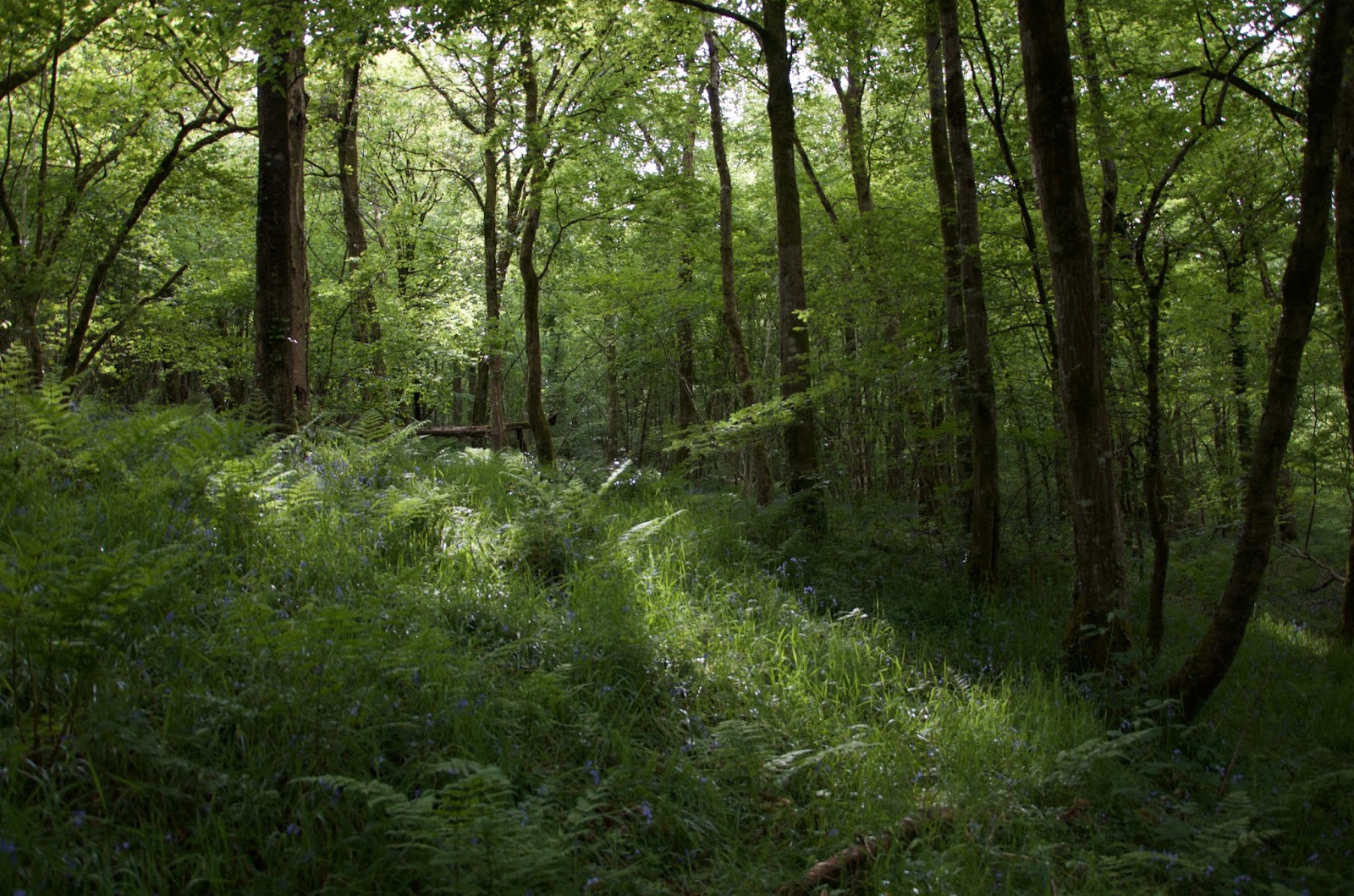
| Woodland feeling, Surry, UK |
The mind-set of a creator guiding the emergence of a garden
becomes crucial to the process. The training of a gardener in Japan is as much
about the refining one’s the perception of space, and the way in which the
patterns of energy combine. For example, seeing the spaces between the forms as
being as important as the forms themselves. This is referred to as ‘ yohaku’, or white space, and acquaints
to the areas of a painting that are deliberately left blank. The apparently
‘empty’ spaces define the forms, giving them contrast, depth and dimension. A
carefully selected and displayed stone, or pine, will reveal its presence, its
form. The viewer will sense its energy, and be moved by it. It is a
characteristic of the Japanese approach that the viewer is placed at the centre
of the creation process. When creating a garden, I am constantly thinking and aware
of how does the viewer discover and observe the scenery being created. What is
to be seen from this point, from that? Does each position reveal a sense of
harmony and balance? What is the journey the viewer has to make to get from
this point to the next, what will they see, what will they experience?
 |
| Hotei laughs by the stream. Surrey, UK |
In the Japanese style garden the viewer’s attention is
directed towards the quality of things. The patina of stone, wood and water;
each will have its own particular quality, and so its own emotional resonance
in the viewer. The garden creator becomes fine tuned to the quality of things. First
evoking ‘instability’ and then resolving that issue creating Balance. A central
key stone is placed and another stone is added until a grouping is formed,
usually of three, five or seven elements. A principal feature plant is set in a
certain place with purpose and deliberation. Garden scenery is built up element
by element, layer by layer. An important difference in creating gardens in
Japan and in the West is that whenever possible, all the planting elements are
planted at a size and bulk that is near as possible to full height and ultimate
shape. Plant nurseries in Japan produce material that is mature and have been
guided, sometimes over generations, into a variety of shapes. At the completion
of the build process the garden is complete in itself. It is rarely possible to
do this in the Western garden context, as the plant material is rarely
available at the same level of maturity. Here the gardener has to develop that
material him or herself, or else also try and incorporate existing material to
the best effect. It seems only logical that there should be scope to
incorporate a wider range of planting the Japanese style garden, based in the
plant knowledge of the Western gardener. One needs to be looking at plants (trees,
shrubs and even herbaceous material) for what they can offer as textures, as
well as forms, and how these may work in the context of what gives a sense of
visual interest and emotional harmony to the person experiencing the garden. Just
as the landscape painters of Sung dynasty China sought more than a
representation of landscape, so the garden creator seeks to express something
of the spirit of landscape, its soul. In so doing it is necessary to identify
with, and align us with, the ‘spirit’ being sought. This is a question of
allowing the forms, the patterns of energy to speak for them selves, so
allowing them to reveal themselves for what they are. A tree has a different
energy to a rock, as it has to a shrub, or a patch of moss, grass, blue sky or clouds.
 |
| Tea house by pond, Oxford, UK |
This is to recognise that landscape is inherently sacred. In
most cultures the landscape has been recognised as being the ultimate source of
spiritual and moral authority. It was in the landscape that humans communicated
with the deities at sites identified as being saturated with potent energy.
Landscape was understood as being seen as a reflection of self. Through the
landscape we humans come to know ourselves in relation to our environment. We
can see ourselves, as an integral element of the world we live in, not
separated from but inseparable from the environment that supports us. The
garden is an abstraction of the relationship between us and our environment,
and an attempt to distil that quality and so to bring it closer to our daily
life experience.
If you enjoyed this blog then try my Facebook page, Robert Ketchell Garden Design. Feel free to leave comments there. Good gardening.
If you enjoyed this, or any other post, please let me know! If there are specific aspects of the Japanese garden tradition you are interested in, please let me know. Thanks.