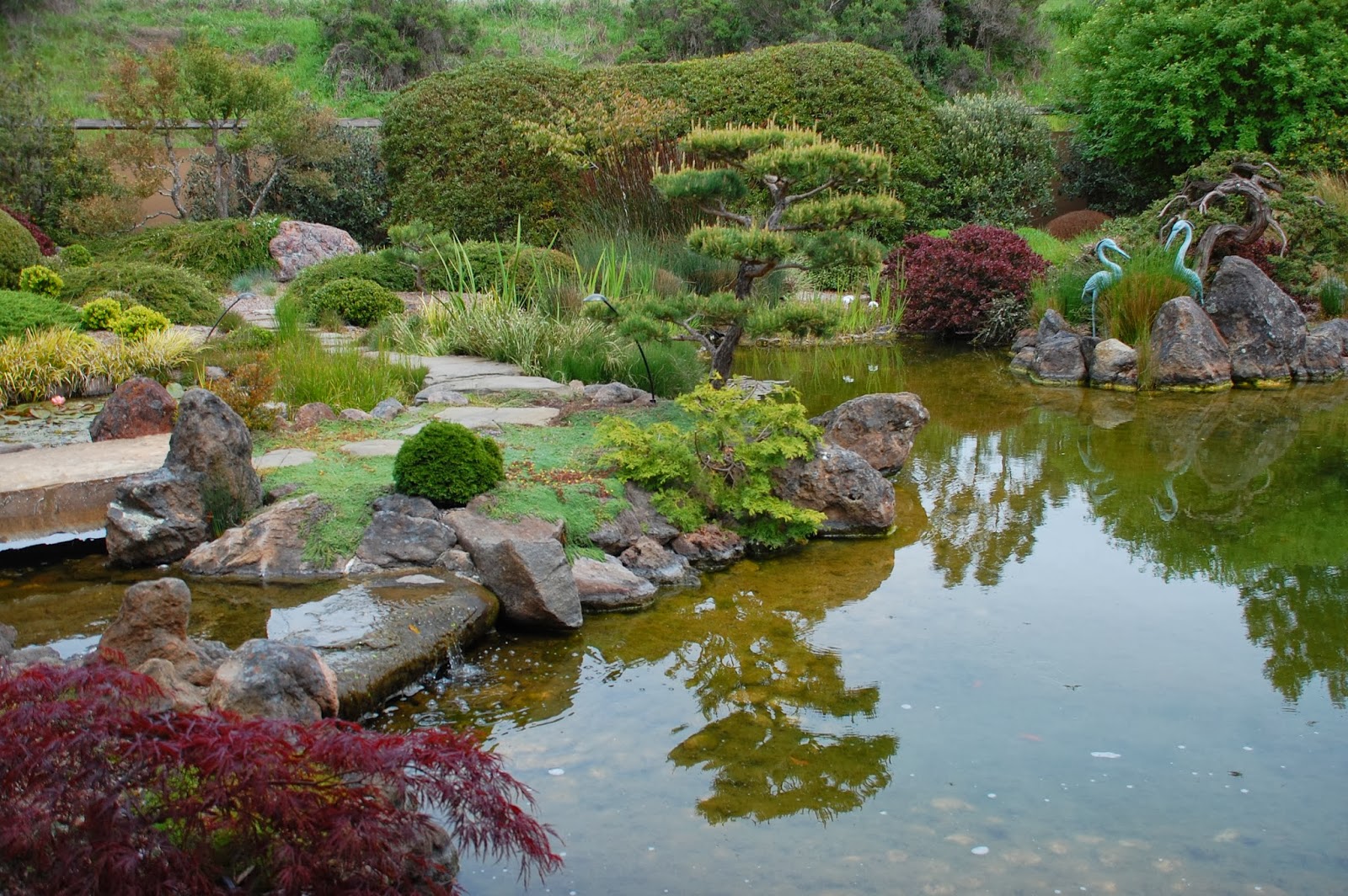
The arrangement of stones in the garden is an important element of the Japanese garden, and the manner in which this is done is quite distinct. In this section we will begin to look at the way in which stone arrangements are created. Selecting stones for a garden arrangement can seem like something of a mysterious process in its own right, we also look at the qualities of stones that make them suitable for inclusion in a Japanese style garden.
Stones come in all manner of forms, shapes and sizes. In thinking about placing them in a garden setting there are some basic practical considerations to take into account. It is usually necessary to research the local area to find suitable sources of stone that can be used in the garden, as it may well be the case that stone may need to be brought in from some distance if there are not suitable sources locally. Bringing in stones from any distance will increase the cost per ton of the stones, as transport costs are a major element of their overall price. Garden centres may sometimes supply rockery stone to the general public, but these tend to be smaller pieces, and are generally quite expensive. It is better to find a reputable stone supplier whom you can visit to see their stocks, and talk to them about the range of stones they can supply, and also visit to look at the stone they have in stock. Quarries are increasingly a more difficult source of stone for garden purpose. Generally quarries are interested in shifting material in large quantities, so much is broken up into road stone and shipped out, or it may be cut for specific purposes. In general nowadays it is not possible to visit quarries due to health and safety regulations, so one has to go through an intermediary supplier. Also removing pieces of stone from the landscape is forbidden in many countries, and should rightly be discouraged as a practice. Though I did a project in Scotland many years ago where I visited the local farms and was able to find a farmer only too happy to remove large field-stones for several fields, and for a modest price he even delivered them to site instead of simply dumping them along the field boundaries. It is also vital to check on the manner of delivery. The best way of unloading stones is via a crane off-load or similar, rather than tipping up the back of a wagon and letting the stone slide off into a pile. That way inevitably damage will be done to the stones at the very least. The particular stones chosen will depend on a variety of factors, location and cost, stone types available, size, access to the area in which stones are to be located, and the ability to move them from the point of delivery. Visiting a well-stocked stone yard can be a confusing process, as you may be looking at stones the size of a small car! Something next to a large boulder will naturally seem quite small, until it is delivered to your front garden and needs shifting to the back of the house!
There is no one type of stone that is ‘right’ for a Japanese garden. I was once told when visiting a potential supplier that, “if you are building a Japanese style garden then you need black stones.” I did wonder at the time where that idea came from. Nor is it necessary to think of using only one kind of stone for a project. It is often the case when one looks at the stones used in the gardens in Japan that they are of differing geological origins. In the past in Japan stones were gathered in the landscape, this practice ceased some time ago, and nowadays one visits stone yards to make a selection. Stones were also acquired as war booty; stones have been given as gifts, and have even been treated as family heirlooms and recycled stones?. In the UK we are blessed with a wide variety of geological material and it is possible to find interesting stones of fine quality for Japanese garden compositions. My own personal preference tends towards glaciated material. The outlines of the stones have been ‘softened’, that is eroded by glacial action into rounding off sharp outlines; also one can find a variety of geological types of stone which will yield different colours and patterns in respect of surface texture. Glacial material is usually obtained by digging up areas where the glacier has deposited stones as it retreats. These are called moraines, and can form quite significant features in a landscape. The quarrying of these areas is carried out under strict controls usually to extract the accompanying sand and gravel deposits and the boulders are a by-product. Much glacial material is igneous or metamorphic in origin, that is stone that has undergone a transformation through heat and/or pressure. It can create a stone with a distinctly crystalline structure, or in some cases a distinctive patterning to the texture and will also vary much due to the particular chemical composition of the material.
Sedimentary rocks would be my second choice for Japanese style garden work; this is stone created by the laying down of layers of fine material such as sands and clays which are then subjected to extreme pressures which in time turn them into rock. Typical sedimentary stone is sandstone, which can vary from being quite soft to extremely dense and hard. Sandstones are usually quarried by breaking up layers of rock and tend to produce sharper angled stones, where one or more face may be relatively flat, also the surface texture of sandstones are plainer than igneous rock, and in the garden setting they can appear darker and more dull. It is a type of stone that suits the Western approach to creating rockeries where the stone is arranged to suggest layer or strata, rather than being placed as individual pieces. Saying that, slate is a sedimentary rock that can be used to create quite dramatic arrangements, if it is possible to find fairly large pieces, and if the situation can bear a strong arrangement, it is an interesting possibility to consider.
 When looking at stones in a stone yard one needs to bear in mind that one is looking to create an arrangement. Will the stones chosen work together as a coherent group in the relevant situation? It can be hard when confronted by a random pile of stones of all shapes and sizes to make head or tail of what you are looking at. Some stones will be upside down, be hidden in part under others, they may be covered in mud that also disguises their colour and texture! It is all too easy to lose track of which stone you saw where. You will also need to imagine the stones being set into the ground in the correct attitude. It is not easy, but then if it was it would not be half the fun it is! Selecting stones is a skill that is honed by experience, there are no real shortcuts, but there are ways to alleviate and enhance the choices you make. An experienced stone arranger will have a ‘gut feeling’ for what will work well together, in some subtle way, he or she will allow the stones themselves to offer themselves up for selection. This is called ‘looking without looking’, keeping an open, yet informed mind.
Broadly speaking there are five types of stones, or five basic patterns that fit into the selection of stones that are used to make up an arrangement. There is no set formula that requires the garden creator to use any particular mix of these stone types, but it forms a useful guide to begin to make sense of a random pile of stones.
The five basic types are:
Tall vertical; this is a stone taller than it is broad. It will stand upright, and very often be the focal point of a group. Can stand 0.9m (3’) or more from the ground.
Low vertical; much the same as above in essence, but a shorter piece. Generally below 0.9m (3’).
Inclining; this refers to stones that have a pronounced diagonal form. They may incline left to right or right to left. Thrusting stones are often used as supporting pieces in triadic groups.
Reclining; this refers to stone that seem to arch from the ground in a more symmetrical manner, that is without a pronounced inclination to the left or right side.
Flat; this refers to stones that sit low and flat to the ground, with a top that has a definite equal plane. Stepping-stones are an example of flat stones.
The definitions of the types of stones are derived from looking at the overall shape or forms of the stones themselves, and an arrangement is usually made up of a selection of different types. It is worth bearing in mind that in arranging stones uneven numbers are used in arrangements. That is, a basic unit of an arrangement would be a 3 stone group, as even numbered groups are avoided. Groupings of stones are made up principally of the numbers 3, 5, 7 or 9 stones. Occasionally a single stone may be used, but it is usually the case that 3,5 or 7 are the most common numbers making up a grouping. Generally, according the Eastern aesthetics even numbers are regarded as being ‘static’, whereas uneven numbers are considered to give a dynamic energy to an arrangement.
‘Static’ in this context is not the same as ‘still’ or ‘stillness’. Static implies a situation where the scales are equally weighted on both sides; thereby the one cancels out the other. In Eastern eyes this outcome is seen as leading to a lack of movement and hence stagnation. From ancient times the Chinese have espoused the concept of yin and yang, which can be understood to be two complimentary but opposing forces or energies (dark and light, high and low, male and female, etc). It is through the interrelationship of yin and yang that the Universe is driven forward; it is the primal energy that fuels the existence of life itself. Yet yin and yang are not simply equal and opposite concepts, because the one is in a constant process of transformation into the other. The one contains the seed of the other within itself, thus within yin there is an element of yang, and vice versa. The one is moving towards the other in the same way that the seasons are constantly in a cyclical process of renewal and transformation. If yin remained yin, and yang remained yang, the possibility of change and renewal would be denied and a situation of stasis would develop, denying movement, change and transformation, so denying life itself. The poet TS Eliot touched upon this in his poem Burnt Norton from the Four Quartets.
…. Words, after speech, reach
Into the silence. Only by the form, the pattern
Can words or music reach
The stillness, as a Chinese jar still
Moves perpetually in its stillness
Not the stillness of the violin, while the note lasts
Not that only, but the co-existence
Or say that the end precedes the beginning
And the end and the beginning were always there
Before the beginning and after the end
And all is always now.
‘Stillness’ in the Eastern sense is a state where the elements are fully, and consciously recognised as being in a process of continuous harmonious transmutation. Then they exhibit a form of dynamism, which is the recognition of potential for change and transformation. A mountain may seem to be the epitome of something eternal, unchanging, yet if we had the eyes to see it over a period of many eons we would also see the mountain be reduced to a single grain of sand. A rock set in the garden may also appear to be something solid, immutable, yet it is what it is at any moment in time because of the extraordinary forces that have gone into the making of it as it is. The rock or stone is the summation of all those incalculable, incomprehensible energies, energies of creation, transformation, erosion and decay. What we are seeing, touching, is a snapshot of time, a fleeting moment of the arc of metamorphosis. The change may be slow and deep, but it is nevertheless irrepressible. This is a very important concept, as in essence the garden creator is looking to work with the apparent dynamic energy of all the materials at his or her disposal, and the ‘trick’ of creating a successful scheme is in working with the myriad different patterns of energy in the arrangement, whilst also allowing a sense of flow or movement to be apparent to the viewer. This cuts to the very heart of the Japanese aesthetic; exhibiting a sense of movement, whilst arranging the various elements of that composition in a harmonious (and hence ‘balanced’) manner.
Looking at a stone whilst deciding how to place it, the garden creator needs to establish three basic criteria; the top, face and root of the stone. The root is the part of the stone to be set in the ground. Often it is quoted that in Japanese stone arrangement one-third of a stone is set below ground. This in practice is not necessarily always followed as an absolute rule. Generally one sets enough of the stone below ground sufficient of the stone to make sure it is stable, and will remain so. Exactly how much of the stone will need to be buried will depend on the shape of the root, and how much of the stone above ground is appropriate to the arrangement being created. A stone where the root section tapers to a point, or forms a narrow ridge, will be inherently more unstable than a stone where the root has a flat broad base. With the former one can also pack small stones or broken rubble in at the base of the stone to give it additional support, or even pack concrete around the base. If you do support the stone with concrete, in situations where absolute security is paramount to ensure that there is no danger of the stone moving in time, then make sure that the finished level of the concrete is below ground and will not show. A stone needs to look stable in the ground and also be stable from a practical point of view. It is always good practice to pound the earth well in around the base of a stone after it has been correctly located to ensure there are no cavities.
The face of a stone is the aspect of the stone that will be projecting toward the principal viewing position. Generally this will be the most interesting aspect of the stone. It is a personal call to define exactly which is the most interesting aspect, but a study of the stone during selection, and before setting will usually reveal a face that is appealing. It may be that a certain face has interesting markings, a well-defined texture or colour. Some stones can be noted to have a well defined face, where one side is more interesting than the other, whereas other pieces may well have interesting aspects on all sides. No two stones are ever going to be alike. In situations where an arrangement will be viewed from multiple positions then great care and attention will need to be taken in both the selection and placement of the stones. A single viewpoint is simpler scenario to deal with, as when there is more than one viewpoint the complexity of the arrangement and the alignment of the stones becomes infinitely more complex. The face of the stone is not always directed full on to the primary viewing position, dependent on the exact outline of the stone and its position within the group, it may be the case that the face of the stone is set to be angled slightly one way or another towards the viewer. This fine-tuning of a stone will need to be decided upon by the garden creator in the moment when setting the stone.

The top of the stone is the part of the stone that sits uppermost when it is in position. The top may vary from a point, through being a domed shape to being flat, or indeed anywhere between those parameters. As noted above every stone will be unique and present the garden creator with a fresh challenge on every occasion however experienced he or she may be. With each stone one is responding to the individual nature of the stone, looking and listening to what the stone itself tell you. 'Set the stone according to the way it asks to be.' That was the advice written in the 'Sakuteiki' in 11th century Japan. It still works today.
To follow this blog:
the 'Follow by E-mail' facility is now operating.
Don't miss a beat and sign in.